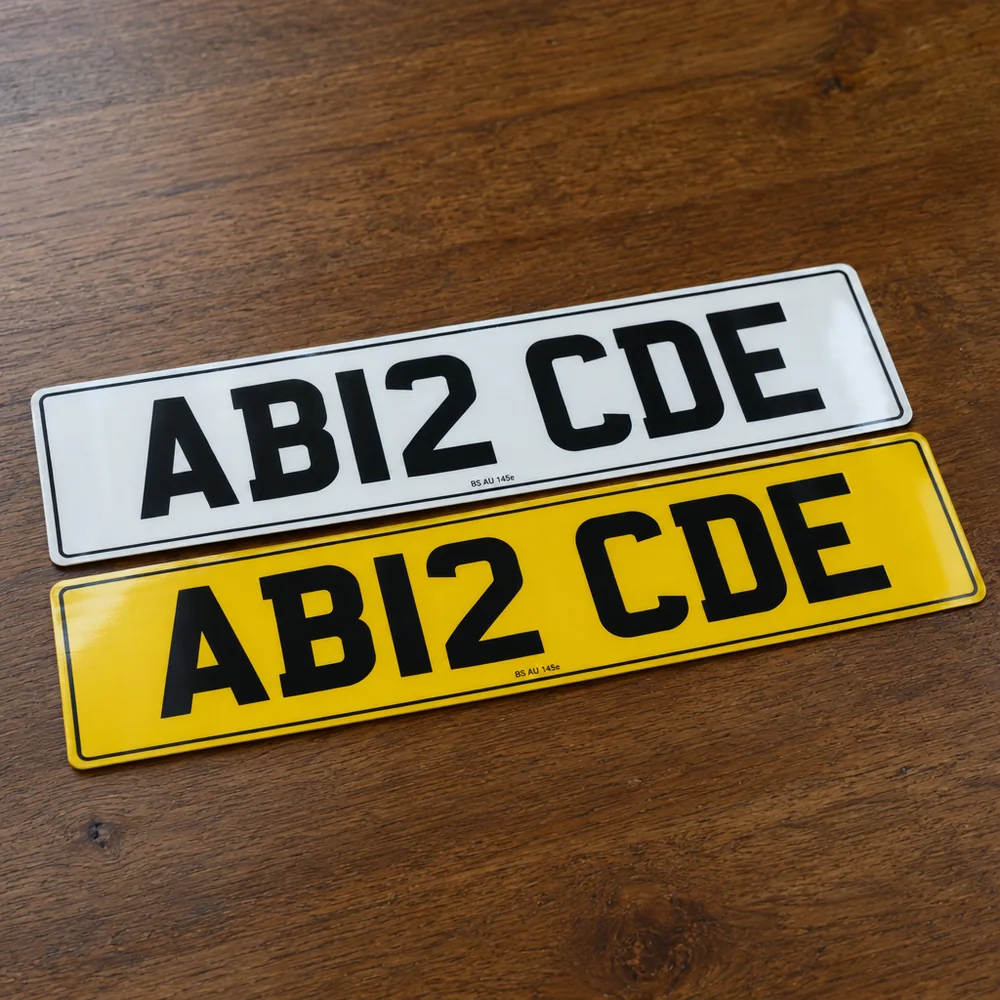
Every road-legal number plate in the UK uses the same typeface. It’s known as Charles Wright 2001 (or the “mandatory typeface”), and since 1 September 2001 it has been the only font allowed on plates for road use. Here’s why it exists, how to recognise it, and what happens if you use something else.
In this guide
Where the font came from
The name goes back to Charles Wright, a sign-maker whose typeface was used on British plates for decades. Before 2001, plate makers used a variety of similar fonts, which made life harder for police and for the Automatic Number Plate Recognition (ANPR) cameras that were becoming common.
The 2001 regulations fixed a single, precisely drawn typeface for all new plates. Its characters were tweaked so that commonly confused pairs – B and 8, D and 0, I and 1, S and 5 – look clearly different to both a human eye and a camera.
What makes it distinctive
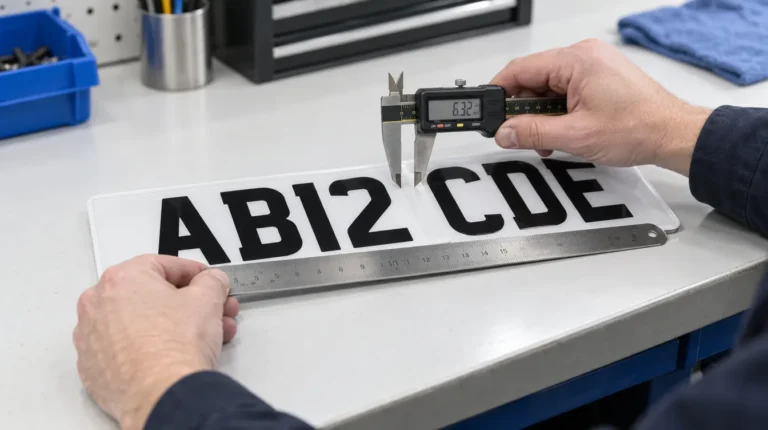
- Narrow, upright characters – each one is 50mm wide and 79mm tall on a car plate.
- A uniform 14mm stroke – every line is the same thickness.
- Flat terminals – strokes end with square cuts rather than rounded ends.
- A plain 1 and I – both are a single vertical stroke 14mm wide.
- Open shapes – the gaps in letters like C, G and S are wide enough to read at distance.

The characters on our plates are drawn to these exact proportions, and the plate builder shows them to scale so you can see precisely what you’re ordering.
Which fonts are illegal?
Anything that isn’t the mandatory typeface, including:
- italic or slanted lettering
- “Gothic”, script or decorative fonts
- bold “sport” fonts with thicker strokes
- rounded or stencil-style characters
- modified characters, such as a 4 made to look like an A
These aren’t just a style problem. Unusual fonts can make a plate unreadable to ANPR, which is why using one carries a fine of up to £1,000 and an automatic MOT failure.
Does the font apply to 3D and 4D plates?
Yes. Raised plates must use exactly the same character shapes. A 4D plate cut in a different typeface is illegal, however neat it looks. See are 3D and 4D number plates legal?
What about older vehicles?
Plates made since 2001 must use the mandatory font. Some historic vehicles still carry older, pressed-metal plates in pre-2001 styles, and vehicles built before 1980 in the historic tax class can display traditional black and silver plates.
Custom fonts on show plates
If you love a particular style, you can still have it – on a show plate. Show plates can use rounded, heavy or slim lettering, colours and slogans, as long as they never go on a car that’s driven on public roads. Switch the builder to “Show plate” to try them, or read show plates explained.

Frequently asked questions
Can I download the Charles Wright font?
Lookalike versions exist online, but a font file alone doesn’t make a legal plate. The plate also needs the right materials, BS AU 145e marking and a registered supplier.
Is the font the same on motorcycle plates?
Yes, but smaller: motorcycle characters are 64mm tall and 44mm wide with a 10mm stroke.
Are bold characters legal?
No. The stroke thickness is fixed at 14mm on car plates. Thicker “bold” lettering is only for show plates.
Does the legal font apply in Northern Ireland?
Yes. Northern Ireland plates follow the same display rules and typeface.