Number plates look simple, but the rules behind them are surprisingly precise. The characters, the spacing, the colours, the material and even the small print along the bottom edge are all set by law. Get any of them wrong and you risk a fine of up to £1,000, an MOT failure and, for private registrations, the DVLA taking the number back.
This guide pulls every rule into one place for 2026. It is written for drivers, but it is the same checklist we use when we make plates, so you can use it to check any plate – ours or anyone else’s.
In this guide
- The law behind your number plate
- Colours, material and background
- The font: Charles Wright 2001
- Character sizes, spacing and margins
- Plate sizes and shapes
- 3D, 4D and 5D raised plates
- Flags, badges and national identifiers
- The supplier mark and BS AU 145e
- Buying plates: the registered supplier rules
- Show plates are different
- Fines, points and MOT failures
- A quick legal plate checklist
- Frequently asked questions
The rules in 30 seconds
- Black characters on a white front plate and a yellow rear plate, made from reflective material
- The Charles Wright 2001 font, with characters 79mm tall and 50mm wide
- Correct spacing: 11mm between characters and 33mm between the two groups
- No background patterns, no removable or reflective characters, one shade of black
- Plates fitted from 1 September 2021 must meet BS AU 145e and show the supplier’s name and postcode
- Raised 3D and 4D characters are legal if everything above is met
- Only certain flags and identifiers are allowed on the left-hand side
The law behind your number plate
Two things govern a UK number plate. The first is the law itself: the Road Vehicles (Display of Registration Marks) Regulations 2001, which set out the layout, the characters and what may and may not appear on a plate. The second is the British Standard the plate is made to, which covers how tough, reflective and durable the plate must be.
Since 1 September 2021, every newly fitted plate must meet BS AU 145e. Plates fitted before that date to the older BS AU 145d standard are still legal, as long as they are in good condition. You don’t need to replace a good plate just because the standard changed.
The government’s own summary is on GOV.UK – Displaying number plates, and the full regulations are on legislation.gov.uk.
Colours, material and background
A road-legal UK plate must be:
- Reflective – the plate face is made from retro-reflective material so it can be read at night and by cameras.
- White at the front and yellow at the rear, with black characters on both.
- Plain behind the characters – no patterns, pictures, honeycomb or carbon-effect backgrounds.
The characters themselves must not be reflective, and on plates fitted since September 2021 they must be a single shade of black. That last rule is the one that ended the two-tone “3D effect” printed plates that were popular a few years ago.
There is one exception to the white-and-yellow rule. Vehicles built before 1 January 1980 and taxed in the historic vehicle class can display traditional black and silver plates. We explain who qualifies in our guide to black and silver number plates.
The font: Charles Wright 2001
Every road-legal plate made today must use the mandatory typeface, usually called Charles Wright 2001. It was designed to be read quickly by people and by Automatic Number Plate Recognition (ANPR) cameras, with each letter shaped so it can’t easily be mistaken for another.
That means no italic, script, bold “sport” or “Gothic” fonts, and no altering characters to make them spell something. A “5” can’t be made to look like an “S”, and you can’t use screw heads to change a letter. You can see the shapes in detail in our guide to the legal number plate font.
Character sizes, spacing and margins
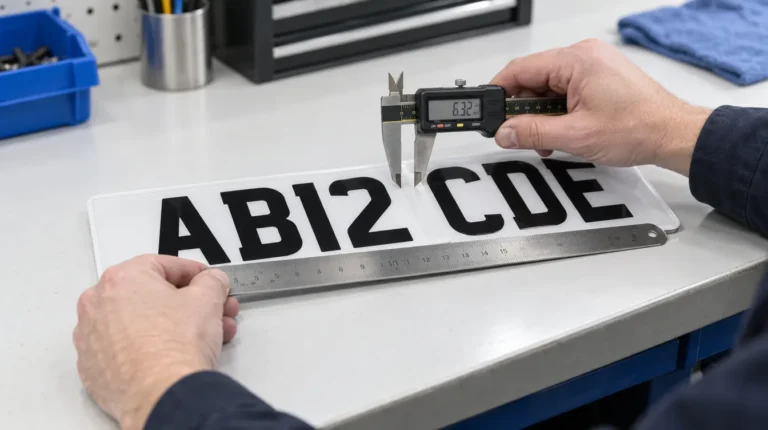
The regulations fix the exact size of every character and gap. On a car plate:
| Measurement | Car plates | Motorcycles (from Sept 2001) |
|---|---|---|
| Character height | 79mm | 64mm |
| Character width (except 1 and I) | 50mm | 44mm |
| Stroke thickness | 14mm | 10mm |
| Space between characters | 11mm | 10mm |
| Space between the two groups | 33mm | 30mm |
| Margins (top, bottom and sides) | 11mm minimum | 11mm minimum |
| Space between lines (two-line plates) | 19mm | 13mm |
Spacing is where most illegal plates go wrong. “AB12 CDE” has to be shown as two groups – you can’t close up the gap or move it to spell a name. Our number plate spacing rules guide shows the correct split for every registration format, and the plate builder applies it for you automatically.
Plate sizes and shapes
Surprisingly, the law doesn’t set a fixed plate size. It sets the size of the characters and margins, and the plate has to be big enough to hold them. That’s why the common standard is 520 × 111mm for cars, but shorter “cut to fit” plates can be legal too – as long as the 79mm characters, the spacing and the 11mm margins are all kept.
What isn’t legal is shrinking or squashing the characters to fit a small plate on a car. Two-line square plates (279 × 203mm) are fine for vehicles with a square recess, and motorcycles have their own rules. See our full UK number plate sizes guide and our guide to short and hex plates.
3D, 4D and 5D raised plates
Raised characters are legal. The 2021 standard specifically allows them, which is why 3D gel, 4D laser-cut acrylic and 5D (4D with a gel top) plates can all be road legal. The conditions are the same as for any plate: Charles Wright font, correct size and spacing, a single shade of black, and a BS AU 145e-compliant plate from a registered supplier.
Where raised plates become illegal is when they’re paired with coloured characters, two-tone effects, the wrong font or non-standard spacing. We cover this in depth in are 3D and 4D number plates legal? and compare the finishes in 3D vs 4D vs 5D number plates.

Flags, badges and national identifiers
You may show one of the following on the left-hand side of the plate:
- Flags: the Union flag, the Cross of St George, the Cross of St Andrew (Saltire) or the Red Dragon of Wales.
- Identifiers: UK or United Kingdom, GB or Great Britain, CYM or Cymru, ENG or England, SCO or Scotland, or Wales.
The flag must sit above the identifier, neither can be wider than 50mm, and neither can intrude into the margin around the registration. Football badges, car-maker logos and other emblems aren’t allowed on road-legal plates.
If you drive abroad, the UK identifier with the Union flag means you won’t need a separate UK sticker in most European countries (Spain, Cyprus and Malta still want a sticker). We explain every option in number plate flags and badges.
Zero-emission vehicles can also have a green flash on the left edge – see green number plates for electric cars.
The supplier mark and BS AU 145e
Look along the bottom of a legal plate and you’ll find small print. Under BS AU 145e it must show:
- the name and postcode of the supplier who made the plate, and
- the British Standard number, BS AU 145e.
That legend is how police and the DVLA trace where a plate came from. A plate without it, or with a made-up name, isn’t legal. Our plates carry our business name and postcode on every road-legal order.
Buying plates: the registered supplier rules
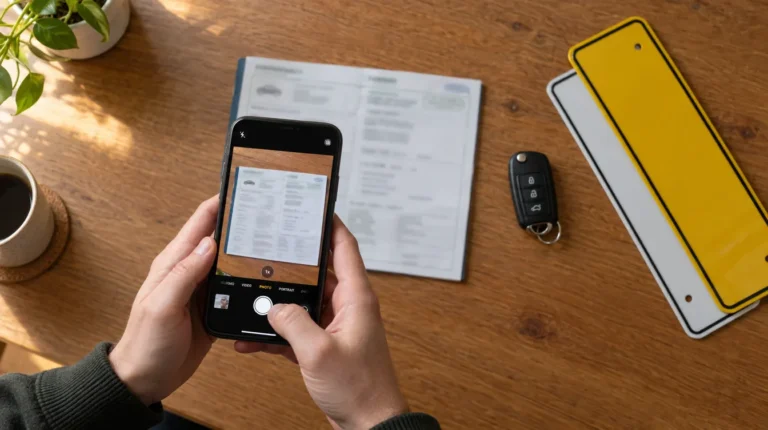
You can only buy road-legal plates from a Registered Number Plate Supplier (RNPS) – a business registered with the DVLA. Before making your plates, the supplier must see original documents proving:
- Who you are – for example a driving licence or passport, and
- That you’re entitled to the registration – usually your V5C logbook, or a V750 or V778 certificate for private numbers.
The supplier also has to keep a record of each sale for three years. That’s why we ask you to upload your documents at checkout. It isn’t red tape we’ve invented: it’s the law, and it’s what stops criminals ordering copies of your plates. Our guide to the documents needed for number plates lists every accepted document.
In 2025 Amazon stopped selling number plates in the UK after a BBC investigation found sellers supplying plates without these checks. If a website doesn’t ask for documents for a road-legal plate, it isn’t following the rules.
Show plates are different
Plates with custom text, other fonts, colours or bubble shapes are show plates. They’re legal to buy, own and display at car shows, on private land or on your wall – but not on a vehicle driven on public roads. Read show plates explained before ordering one.
Fines, points and MOT failures
The penalty for an incorrectly displayed number plate is a fine of up to £1,000. Plates that don’t meet the rules also fail the MOT, and the DVLA can withdraw a private registration that’s being misrepresented.
Deliberately disguising a plate to dodge cameras – so-called ghost or stealth plates – is treated far more seriously, and the government has been consulting on tougher penalties including penalty points. See illegal number plate fines and our guide to ghost and tinted plates.
A quick legal plate checklist
Before you fit any plate, check:
- White front, yellow rear, black characters, reflective plate
- Charles Wright font, 79mm characters, correct spacing
- Nothing behind the characters except a plain background
- Only a permitted flag or identifier on the left, if any
- Supplier name, postcode and BS AU 145e along the bottom
- Clean, undamaged and securely fixed, with a working rear plate light
Design your plates in under a minute
Type your registration to see road-legal 3D gel, 4D and 5D plates drawn to scale, with legal spacing applied automatically.
Frequently asked questions
Are 4D number plates legal in 2026?
Yes. Raised 4D acrylic characters are legal as long as the plate meets BS AU 145e, uses the Charles Wright font, the characters are a single shade of black and the spacing is correct.
Do I have to replace my plates because of BS AU 145e?
No. The standard applies to plates fitted from 1 September 2021. Older plates made to BS AU 145d are still legal if they’re in good, readable condition.
Can I have a smaller number plate on my car?
Yes, if the plate still fits legal-size characters, correct spacing and 11mm margins. The plate itself can be cut shorter, but the characters can’t be shrunk.
Is a black border legal on a number plate?
A plain, non-reflective border is acceptable as long as it doesn’t intrude into the margins around the characters. We keep borders thin and black on road-legal plates.
Why do I have to send ID and my V5C to buy plates?
Registered suppliers are legally required to see proof of your identity and entitlement to the registration before making road-legal plates. It protects you from someone cloning your registration.
What happens if my plates are illegal?
You can be fined up to £1,000, your car will fail its MOT, and if it’s a private registration the DVLA can take it away.