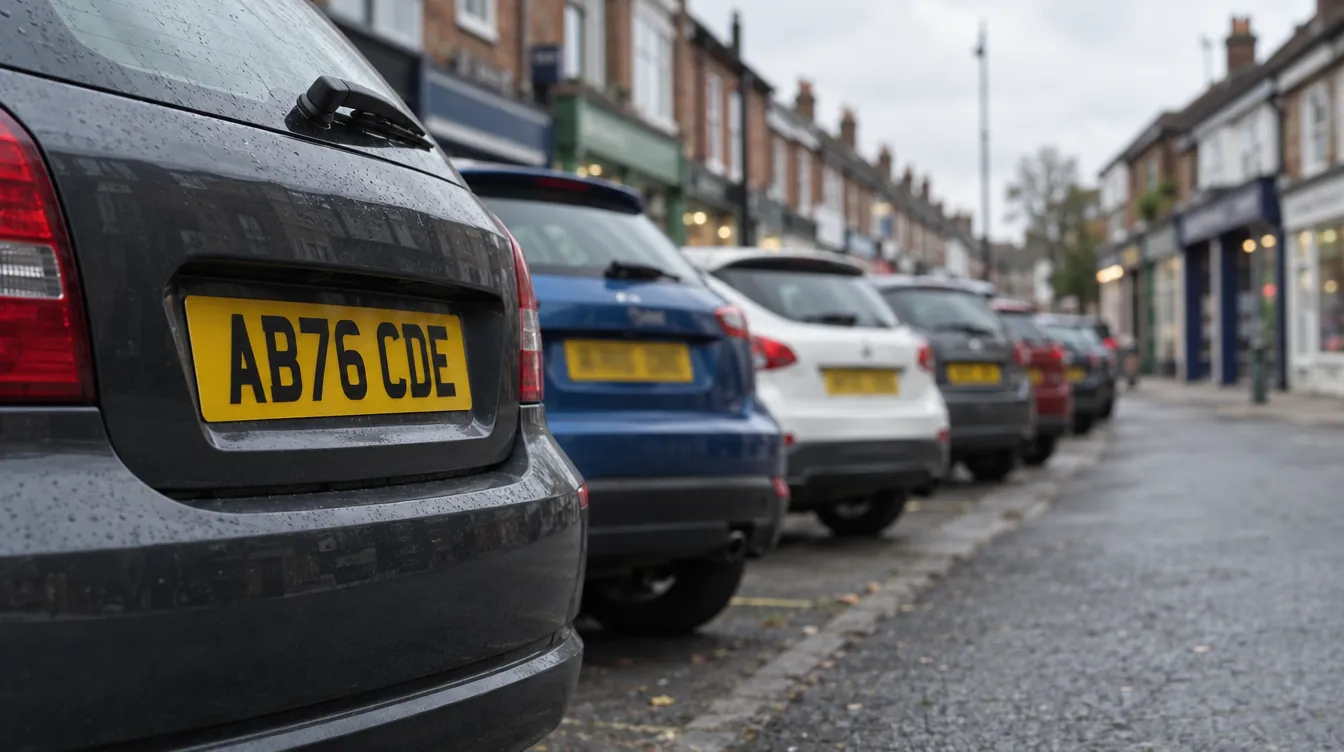
A current-style UK registration like AB76 CDE packs in three pieces of information: where the car was first registered, when, and a random sequence that makes it unique. Once you know the code, you can read any modern plate at a glance.
In this guide
The three parts of a current registration

| Part | Example | Meaning |
|---|---|---|
| Memory tag (first two letters) | AB | The region (A) and DVLA office area (B) where the car was first registered |
| Age identifier (two numbers) | 76 | When it was registered – here, September 2026 to February 2027 |
| Random letters (last three) | CDE | A unique sequence |
The letters I, Q and Z aren’t used in the random part of current registrations, and Q is reserved for vehicles whose age or identity can’t be established.
How age identifiers work
Age identifiers change twice a year:
- 1 March: the identifier is the last two digits of the year – 26 for March 2026.
- 1 September: add 50 – 76 for September 2026.
So the next identifier, from 1 March 2027, is 27, followed by 77 in September 2027. Read more in when do new number plates come out?
| Year | March | September |
|---|---|---|
| 2001 | – | 51 |
| 2002 | 02 | 52 |
| 2005 | 05 | 55 |
| 2010 | 10 | 60 |
| 2015 | 15 | 65 |
| 2018 | 18 | 68 |
| 2020 | 20 | 70 |
| 2021 | 21 | 71 |
| 2022 | 22 | 72 |
| 2023 | 23 | 73 |
| 2024 | 24 | 74 |
| 2025 | 25 | 75 |
| 2026 | 26 | 76 |
| 2027 | 27 | 77 |
Area codes: the first letter
The first letter of the memory tag is the region; the second narrows it to a DVLA area within it.
| First letter | Region |
|---|---|
| A | Anglia (Peterborough, Norwich, Ipswich) |
| B | Birmingham |
| C | Cymru / Wales (Cardiff, Swansea, Bangor) |
| D | Deeside to Shrewsbury (Chester, Shrewsbury) |
| E | Essex (Chelmsford) |
| F | Forest and Fens (Nottingham, Lincoln) |
| G | Garden of England (Maidstone, Brighton) |
| H | Hampshire and Dorset (Bournemouth, Portsmouth, Isle of Wight) |
| K | Milton Keynes, Luton and Northampton |
| L | London (Wimbledon, Stanmore, Sidcup) |
| M | Manchester and Merseyside |
| N | North (Newcastle, Stockton) |
| O | Oxford |
| P | Preston and Carlisle |
| R | Reading |
| S | Scotland (Glasgow, Edinburgh, Dundee, Aberdeen, Inverness) |
| V | Severn Valley (Worcester) |
| W | West of England (Exeter, Truro, Bristol) |
| Y | Yorkshire (Leeds, Sheffield, Beverley) |
Not every letter is used as a region code. Since registrations are now issued by dealers across the country rather than local offices, the memory tag reflects the dealer’s area rather than where the owner lives.
Older formats: suffix and prefix
| Format | Years | Example | How to read it |
|---|---|---|---|
| Suffix | 1963–1983 | ABC 123D | The final letter shows the year (A = 1963 onward) |
| Prefix | 1983–2001 | A123 BCD | The first letter shows the year (A = 1983–84 through Y = 2001) |
| Dateless | Before 1963 | ABC 123 | No year shown – these can go on any vehicle |
| Northern Ireland | Since 1903 | ABZ 1234 | Contain I or Z; no age identifier |
Dateless and Northern Ireland registrations are popular as private plates precisely because they don’t show the car’s age. See private number plates.
Frequently asked questions
What does 76 on a number plate mean?
The car was first registered between 1 September 2026 and 28 February 2027.
What will the March 2027 plate be?
27 – used from 1 March to 31 August 2027.
Can I put a newer registration on an older car?
No. You can’t use a registration that makes a vehicle look newer than it is. You can put an older or dateless registration on a newer car.
Does the area code show where the owner lives?
No – it shows where the vehicle was first registered, usually where the dealer is based.